What can a large UV and UV-DTF hybrid do?
The video of 16 February 2025 reviews an updated UV and UV-DTF hybrid: a printer for printing directly on objects and making stickers on film. It shows design changes and a test run. Click a time to play the video from that point. The video is in Russian.
Questions and answers by the minute
0:13 What objects can a large hybrid UV printer print on?
The video mentions a 60 by 90 table and objects up to 25 cm tall. The machine has three i3200 printheads and water cooling. UV-DTF rolls are fitted for stickers, so the roll section can be used when there are no orders for printing on objects.
1:11 Do you need to remove the rolls to print on objects?
On the version shown, the rolls stay in place when printing on the table. A switch selects the mode. The vacuum, which uses suction to hold the film in place, is switched on separately for the table and the roll section.
2:08 Does the hybrid UV-DTF printer's laminator need a compressor?
The laminator shown, the unit that joins the films together, does not need a compressor. Turning a knob raises and lowers the rollers. The film feeds, tension controls and take-up reel for the finished print are at the back.
3:26 Why is the wiper not used on the hybrid shown?
The wiper, a rubber blade that cleans the heads, is raised by the same motor as the caps, which seal the heads when parked. According to the presenter, when the caps press against the heads, the wiper pushes against the carriage, the moving unit that holds the heads, and may lift it slightly. This observation applies to the design shown.
5:02 Why does the new hybrid version use less film?
The small table and laminator have been placed closer together. Compared with the previous version, the print travels a shorter distance before lamination, so there is no longer a need to feed through a long length of film.
5:32 What changed in the white ink and varnish tanks?
The video says the tank size stayed the same, but more tanks were added. There are now two white ink tanks with two motors and two varnish tanks. According to the presenter, the machine needs refilling less often; ink alarm sensors are fitted.
6:09 Why does the height sensor fail to detect clear acrylic?
In the test shown, the sensor does not detect the transparent blank. An opaque stick of the same thickness is placed beside it to set the table height. This explains the method used in the video for that particular material and sensor.
6:45 In what order are colour and white printed on acrylic?
In the reverse mode shown, where the table moves back, the colour image is printed as a mirror image first, followed by a white background layer. Once the acrylic is turned over, the image should look as though it is sealed inside. The test uses thin lettering, and the presenter acknowledges that adjustments may be needed.
How has maintenance access changed?
In the review, the cover of the carriage – the moving unit that holds the printheads – lifts on hinges. The doors can be removed without undoing screws.
What does the video say about setup?
The video warns that setting up this machine is complicated and involves many details. The design keeps changing, and even the suppliers do not know everything about it.
Which models are in the selection?
The selection below contains similar models. The video does not give the exact name of the machine. The ST-6090Plus in the catalogue lists an object height of 0–23 cm: the limit in the review must not be applied to it. The A3-format IUV-A3UV hybrid and the ST-6090 flatbed printer, which prints on objects placed on a table, are included for comparison.
Equipment in the catalogue
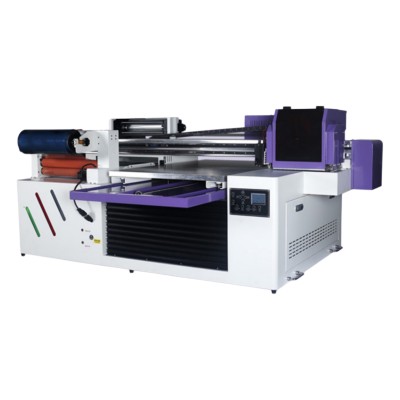 UV DTF printer ST-6090Plus, table 60×90 cm, roll 30 cm
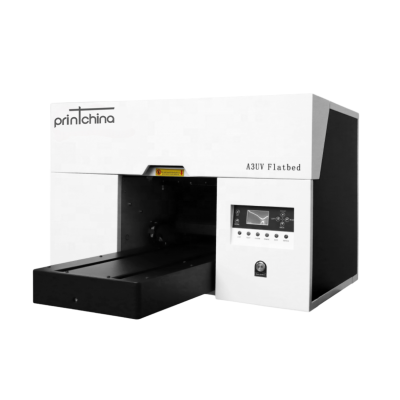 A3 UV printer (IUV-A3UV), i3200-HD, UV and UV DTF hybrid
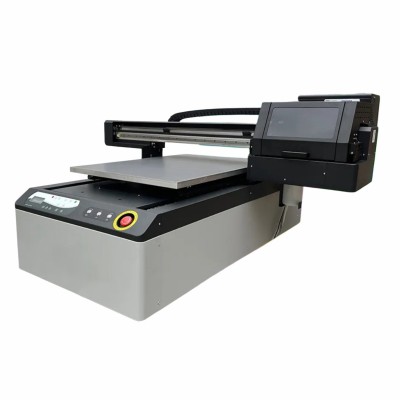 Flatbed UV printer ST-6090, table 60×90 cm, 3 heads