Drawbacks of a hybrid UV-DTF printer after 8 months
A hybrid prints both on objects and on film for UV-DTF, transfers that stick to hard surfaces. The video of 15 December 2024 describes its drawbacks after eight months of work. Click a time to play the video from that point. The video is in Russian.
Questions and answers by the minute
0:00 Why is UV-DTF handier than sublimation?
The video recalls blanks for Christmas baubles used for sublimation, a process that transfers an image using heat. According to the presenter, a misplaced UV-DTF transfer can be carefully removed and the work redone.
1:18 What is awkward about rolls?
Holders are fixed with screws, and rolls are removed before printing on the table. The presenter would prefer quick-release mounts or separate spaces for the roll and table.
2:35 Are the ink and varnish reservoirs big enough?
The video says that this machine has 250 ml reservoirs for ink and varnish. White ink and varnish are used up quickly. It also lacks a wiper, a rubber blade that cleans the printhead, the part that applies ink.
3:26 What about small film jobs?
The presenter explains that film jobs are collected into batches to reduce roll changes. This can mean losing an urgent small order.
3:57 What broke in eight months?
According to the presenter, nothing broke: all three i3200 printheads work reliably. All nozzles, the openings that deliver ink, still work. The presenter recommends i3200 printheads for printing on souvenirs.
4:43 What else could be improved?
The presenter would like a window in the protective cover to see the fluid in the lamp cooling tubes. He also discusses larger ink and varnish reservoirs and a sensor that detects material height. According to the presenter, newer versions already include some of these improvements.
6:02 Does the vacuum get in the way?
The vacuum holds the material against the table by suction and is noisy. The presenter would like to be able to adjust the suction strength.
7:10 Is a separate printhead for glue needed?
The video discusses adding a glue printhead for gold and silver printing. But it would need maintenance and cleaning even when that type of printing is not required.
7:38 How does a roll-fed UV-DTF printer differ?
The roll-fed printer shown in the video has no table for objects, but it has large ink and varnish reservoirs. The laminator, the unit that joins the films, is raised and lowered at the press of a button. Printing transfers does not require removing and reinstalling the roll.
9:26 Can it be used on paper bags?
Application film helps move the transfer onto an item, but its strong adhesive can tear paper when the film is removed. According to the presenter, application film with weaker adhesive has become available for paper products.
Hybrid or roll?
- You print on objects and make transfers: a hybrid with a table.
- You only need transfers: the video shows a roll-fed UV-DTF printer for this task.
What to ask before buying?
This is our own checklist.
- Ink and varnish reservoir capacity and whether there is an alarm for low levels.
- Whether there is a wiper and a material height sensor.
- How to switch from roll printing to printing on the table.
- Which printheads are installed: see heads for UV.
Machines and film
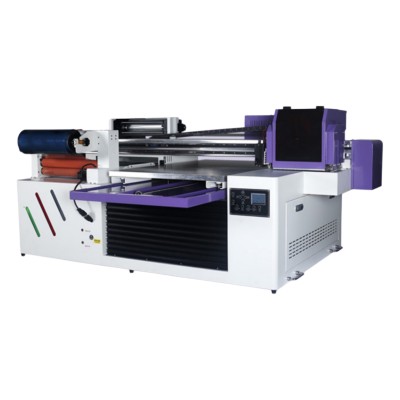 UV DTF printer ST-6090Plus, table 60×90 cm, roll 30 cm
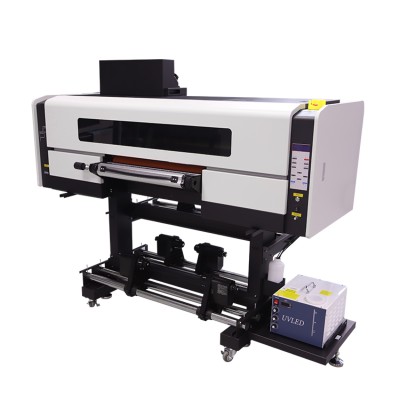 UV DTF printer 60 cm IUV2060-3, 3×i3200
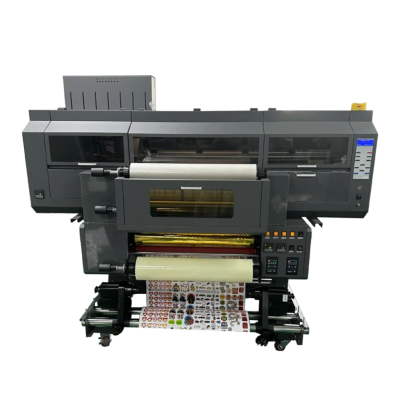 UV DTF printer 60 cm HY-600T, 4×i3200, with automatic foiling
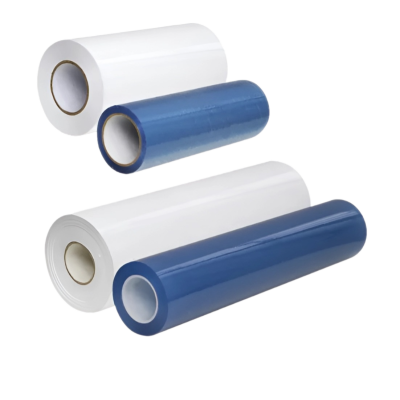 UV DTF film, A+B kit, 100 m roll