MTuTech factory: what to check when choosing a printer?
In the video of 19 July 2026, PrintChina visits the MTuTech factory to show printing on bottles and clothing, machine construction and factory checks. We look at features that matter for small orders and maintenance. Click a time to play the video from that point. The video is in Russian.
Questions and answers by the minute
3:13 How does the printer align a bottle before printing?
The machine scans the bottle and uses a beam and sensor to bring its front and back to the same level. The bottle then rotates around its axis, and white ink printing begins.
4:29 Why is the ink mist collector so far from the bottle?
The engineer in the video explains that excessive suction can spoil fine details in the image. The device therefore collects ink mist that has already drifted away from the bottle.
7:45 How do the printer's sensors protect the operator?
On the printer shown, light sensors run along the area where the machine moves. If a hand crosses the sensors, the machine stops.
11:30 How does the factory's own control board complicate maintenance?
The control board is an electronic part of the printer. According to the presenter, the board for the model shown has to be bought from this factory, and using it means learning another system.
12:26 How can you compare colour reproduction with different inks?
The video shows three identical printers running different types of ink. You can compare the same sample on each to see how the colours change.
17:54 Why can a printing line be inconvenient for small orders?
A roller pulls the film, so even a single print requires feeding a long length of film through to that roller. The lid does not lift, so you cannot place an individual print inside for curing. The presenter notes that the line shown is designed for volume production.
19:44 How do the tables on the clothing printer work?
The tables lower together because they share a common axis. Sensors help prevent contact with the fabric or item. While one item is being printed, the next can be coated with primer, a liquid that prepares it for printing.
22:37 Can a compact printer print on a table, a roll and bottles?
The video shows A3 flatbed printers, machines with a work table. The printer described combines printing on the table, on a roll and on bottles.
24:12 Do you need to check the waste ink container manually?
In the design shown, waste ink drains into a jar under the printer's cover. There is no sensor to detect when it is full, so the ink level needs to be monitored.
29:05 How does the factory check printers during assembly and pass them on for testing?
A magnetic sheet with a checklist is attached to the printer, with marks showing which requirements it meets and where further work is needed. Once checked, the machine is cleared for further assembly. According to the video, it then undergoes 48 hours of testing with continuous operation.
32:14 Can the bottle printer shown handle changes in surface height?
The bottle printer shown in this section has a limitation: it prints only on straight surfaces. According to the presenter, this machine cannot handle changes in surface height.
33:22 Why is the image printed on the bottle several times?
All colours are in a single printhead, the part that applies ink. The video describes this sequence: white first, then black and blue, then yellow and red. For an image with varnish, the same artwork is printed four times.
Where do you start when choosing a machine for your orders?
Use the factory demonstration as a starting point for talking to the supplier. Choose your type of order and ask to see the whole process, from positioning the item to the finished image. This is our list, based on the video.
- For individual prints on film, ask how much material needs to be fed through before the finished print comes out.
- For bottles, discuss the surface shape and the sequence for printing an image with varnish.
- For clothing, ask to see how an item is positioned and how the next one is prepared during printing.
- To compare inks, ask for the same sample on identical machines.
What should you ask about maintenance before buying?
Discuss control board supply and waste ink monitoring separately. Ask which checks the operator needs to carry out and where to check the condition of the parts.
In the bottle printer from the video, the pumps are labelled and arranged in a row, with a container underneath to catch possible leaks. In the compact machine shown, the wires are separated and secured with cable ties. You can include these details in your questions about how your chosen printer is built.
What should you ask to see during acceptance checks?
Ask for the test results for your specific machine and an explanation of any marks indicating further work. For small items, ask which work tables are included: the video shows extra interchangeable tables for these jobs.
Below are similar options from the catalogue for comparison. They have not been confirmed as the models shown at the MTuTech factory; the waste ink arrangements, printing limitations and operating procedures in the video do not automatically apply to them.
Equipment in the catalogue
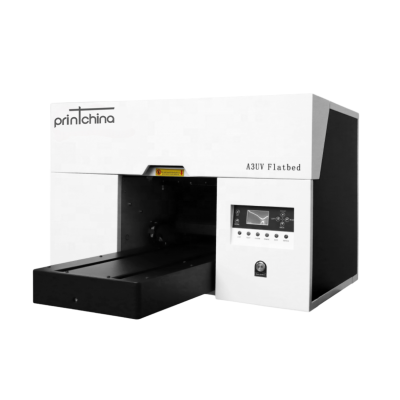 A3 UV printer (IUV-A3UV), i3200-HD, UV and UV DTF hybrid
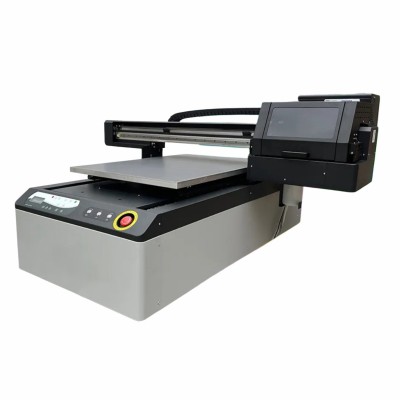 Flatbed UV printer ST-6090, table 60×90 cm, 3 heads
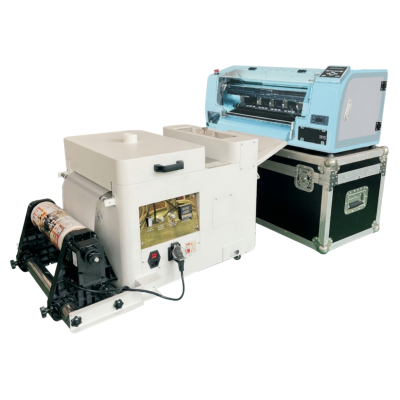 DTF line 30 cm mini, 2 heads